The New Beginning
“Death is not the end of everything, but the beginning of something,” said Pope Francis shortly before his final days - a testament to a faith that sees beyond the grave. The 88-year-old pontiff passed away on Easter Monday, leaving behind a legacy of compassion, humility, and steadfast advocacy for the poor and marginalized.
This photo essay is dedicated to his memory, tracing the journey of Holy Week - from sorrow to resurrection - and honoring his final message of hope beyond endings.
Sicily, the Mediterranean’s largest island, has long stood at the crossroads of civilizations. Its rich cultural fabric reflects centuries of conquest, resilience, and faith, with traces of Greek, Roman, Arab, Norman, and Spanish rule woven into its language, architecture, and traditions.
Despite its beauty and heritage, Sicily has also carried the weight of a darker past. In the 20th century, it became notorious as a Mafia stronghold, casting a long shadow over its reputation. But today, the island is undergoing a quiet transformation. Civic movements and a new generation are working to dismantle organized crime and reclaim Sicily’s true identity.
At the center of this renewal is the island’s deep religious spirit. Catholicism is not just a faith but a way of life, expressed most vividly during Holy Week, when towns come alive with processions and centuries-old rituals that bind communities together in devotion and hope.
The Holy Week in Sicily is a time of profound religious expression, deep-rooted traditions, and powerful community involvement. Although it is celebrated across the island, certain towns - like Enna, Trapani, and Corleone - stand out for the intensity and uniqueness of their rituals. These celebrations reflect centuries of religious, social, and cultural evolution. The processions, garments, and rich symbolism echo Sicily’s layered history, blending enduring local devotion with influences from Spanish rule, which lasted from the late 15th to the early 18th century.
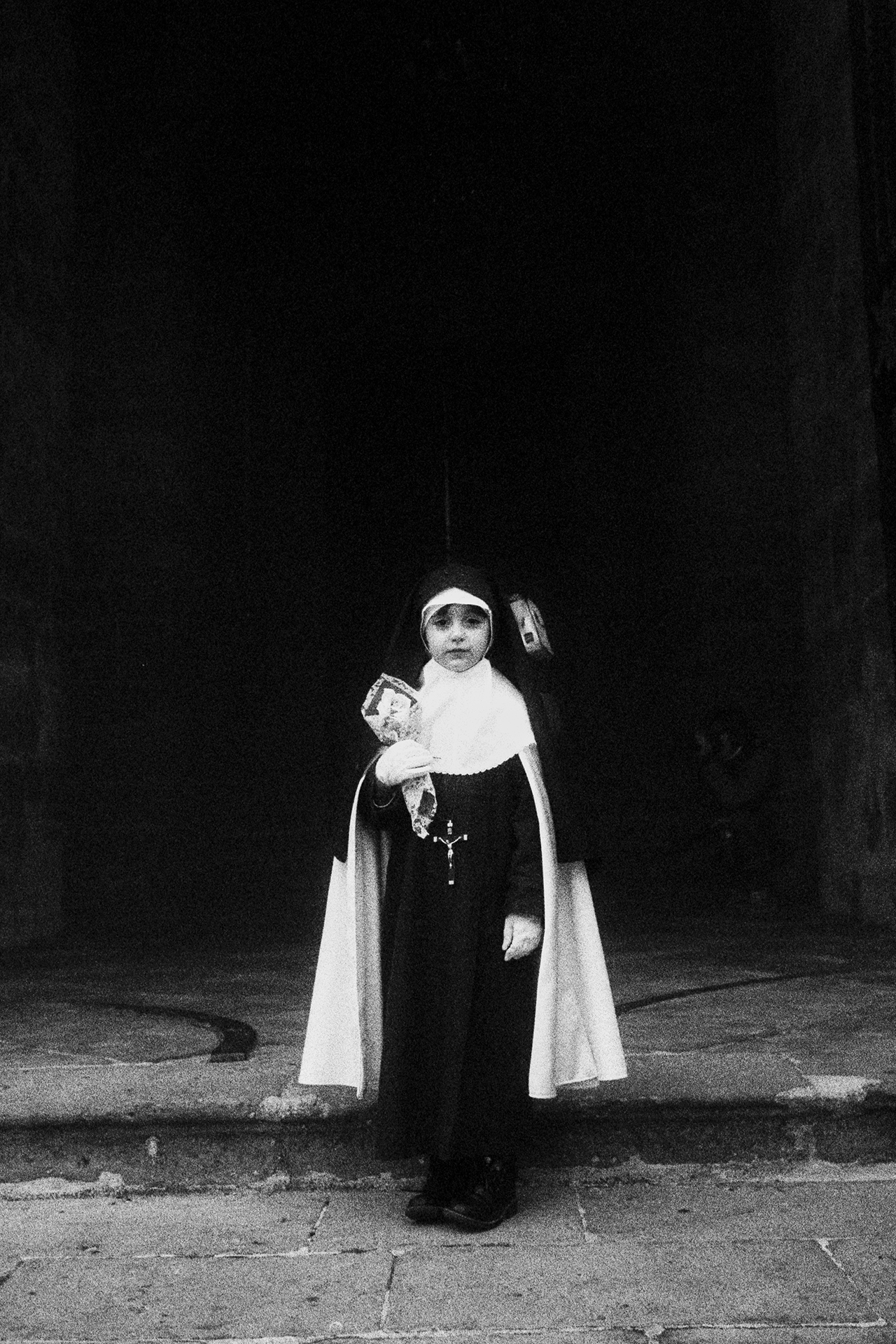
In the heart of the island, the town of Enna is renowned for hosting one of the most solemn and dramatic Holy Week processions. The roots of this tradition are closely tied to the era of Spanish rule, when religious brotherhoods, or confraternities, introduced penitential rituals that have since become deeply embedded in the local identity.
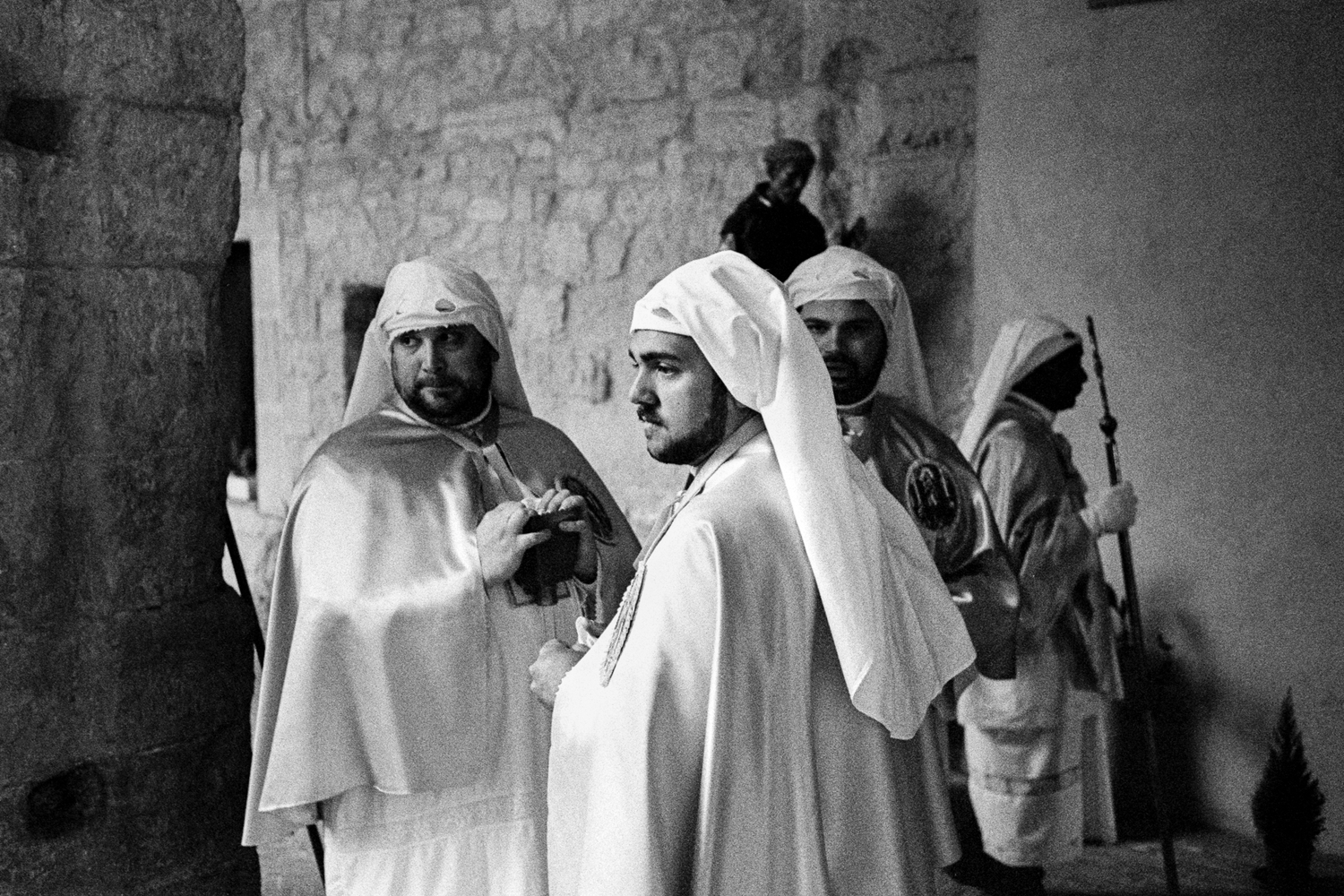
Members of the St. Mary of the Visitation confraternity gather for a procession in Chiesa Parrochiale di San Leonardo in Montesalvo. The confraternity was founded in 1874. Enna, Provincia di Enna
Throughout Holy Week, the processions are interwoven with liturgical celebrations held in the town’s churches. Daily masses, adoration of the Eucharist, confessions, and Tenebrae services create a rhythm of prayer and reflection that draws the entire community into a collective experience of sorrow, anticipation, and eventual hope. The silence, the incense, the slow cadence of the marching, and the tolling of bells all contribute to a sense of timelessness, connecting the present with centuries of tradition.
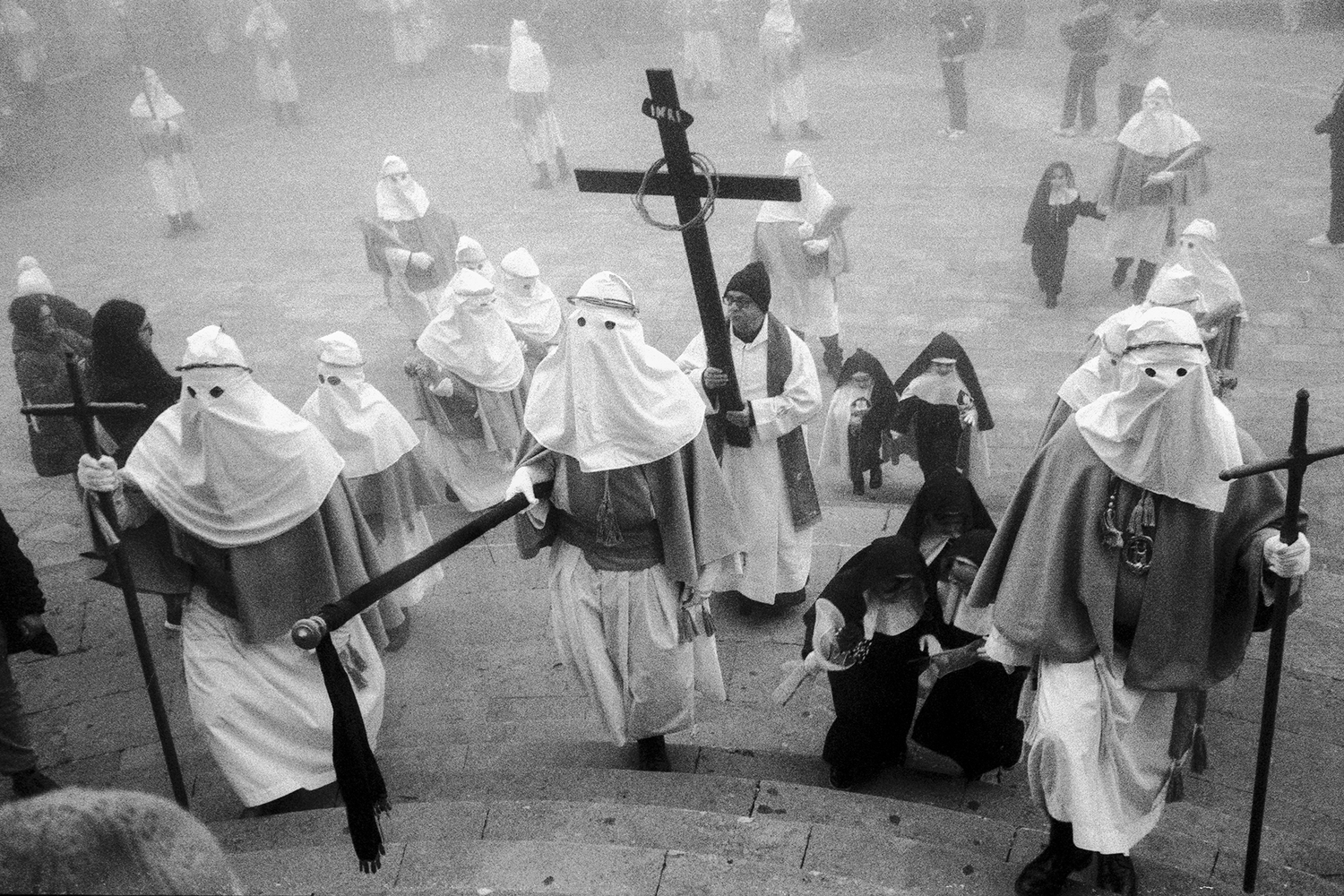
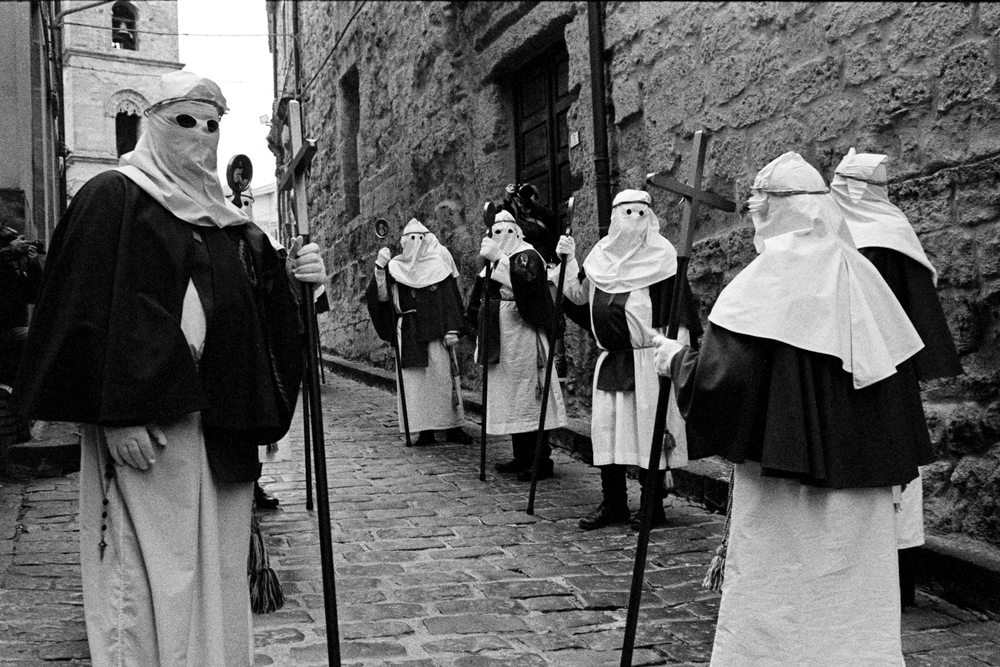
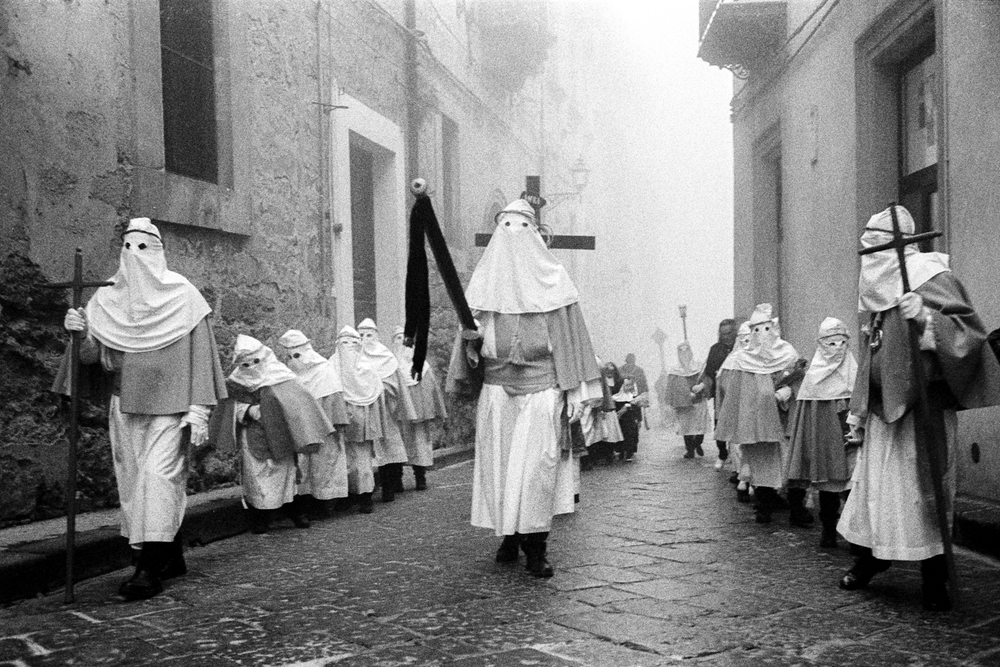
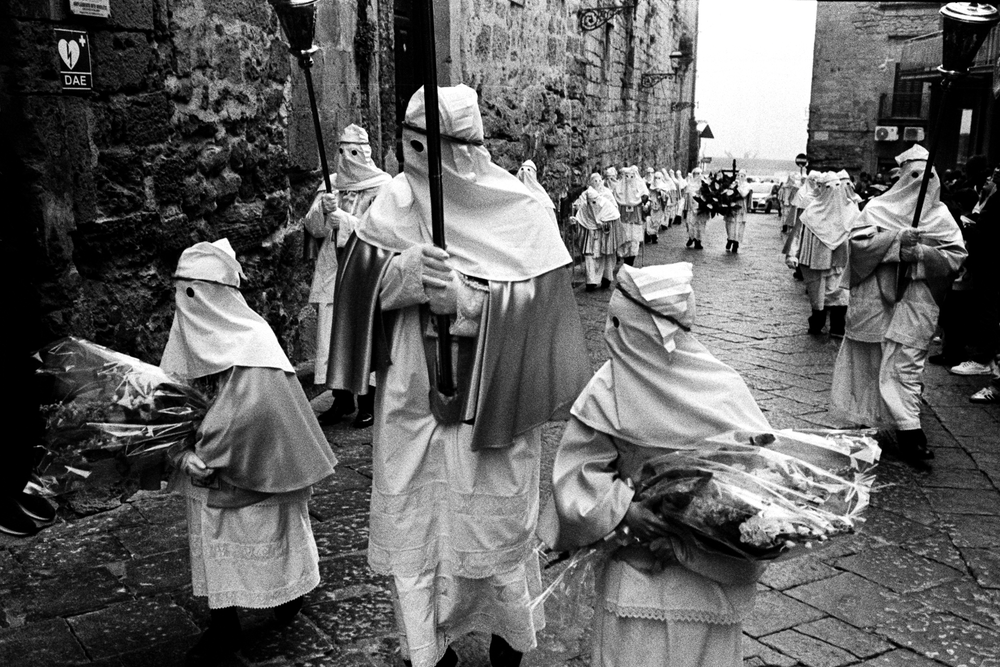
Confratelli (hooded brothers) move in silent procession through the narrow, cobbled streets of the old town towards the Duomo, where the procession ends. Enna, Provincia di Enna.
Clad in long tunics and capirotes - the pointed hoods that fully cover the face - the confratelli move through the streets in silence, each group distinguished by specific colors and emblems. The anonymity provided by the hood carries symbolic weight: it signifies penance, humility, and the collective nature of suffering and reflection. This concealment of individual identity emphasizes that the grief and sacrifice commemorated are communal, not personal.
Unlike their Spanish counterparts, the pointed tops in Enna are tied down, creating a more modest, flattened silhouette. This subtle variation is believed to reflect a deeper sense of humility and anonymity, emphasizing the penitential nature of the procession rather than its theatrical aspect. The cord used to tie the hood can be interpreted as a visual reference to the Crown of Thorns worn by Christ, as a reminder of suffering, sacrifice, and the humility of the Passion.
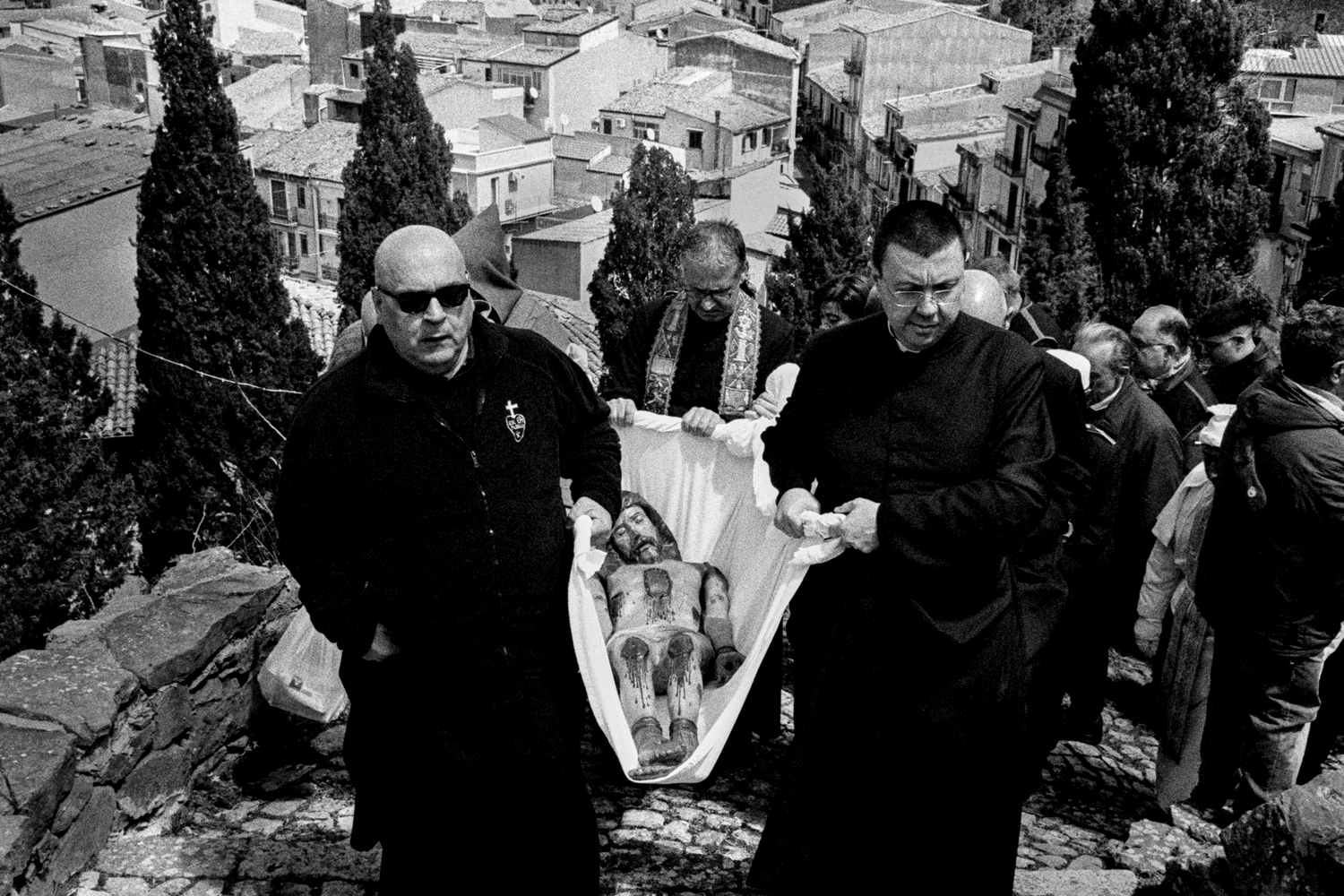
Escorted in solemn procession, the statue of Christ reaches the summit of Monte Calvario, the hill that overlooks the town. Corleone, Provincia di Palermo. Corleone, Provincia di Palermo
In Corleone, the Holy Week processions are particularly evocative, led by members of the White brotherhoods wearing the cammìsu, a long white linen robe, and a colored cape denoting their confraternity. On their heads, they wear hoods with pleated, fan-like tops. Although the concealment of the face was historically common in such processions, this tradition was interrupted in the 1960s when authorities banned face-covering hoods. The measure aimed to prevent local mobsters from using anonymity to conceal their identities, facilitate subtle power plays, or even coordinate violent acts.
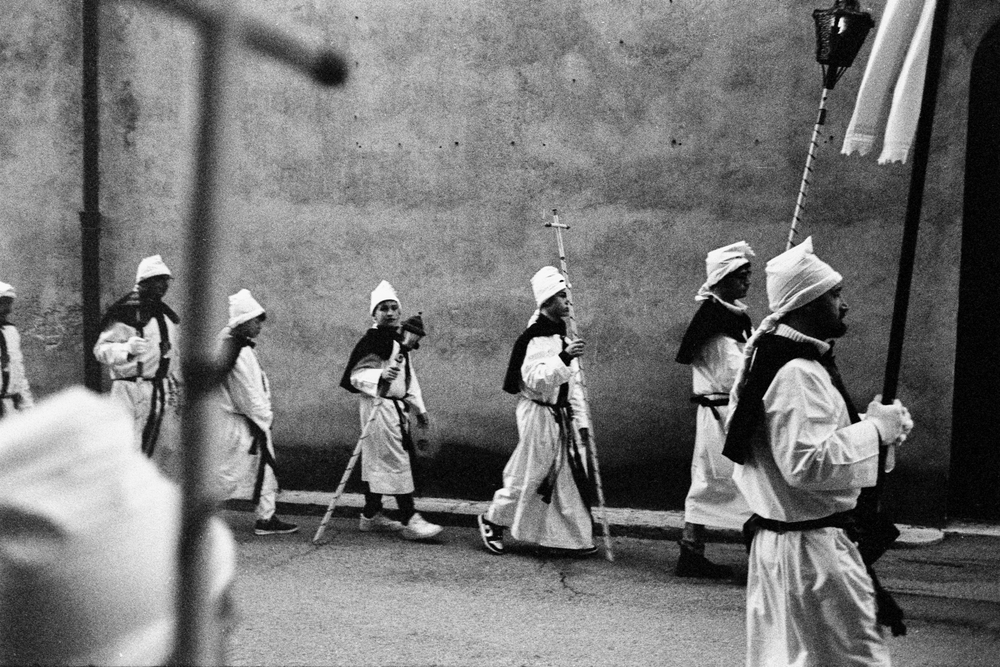
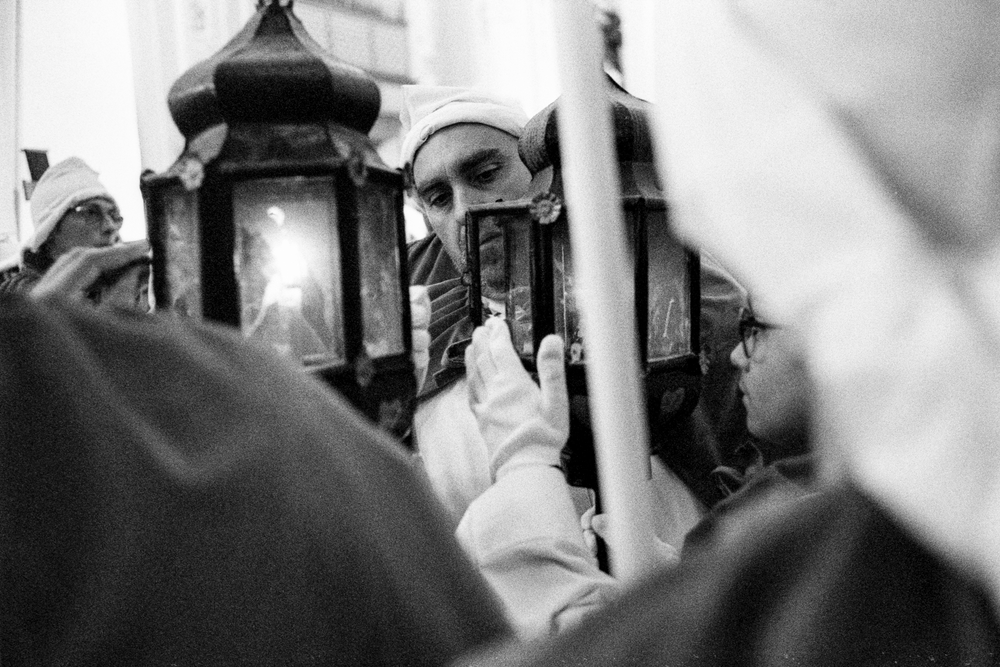
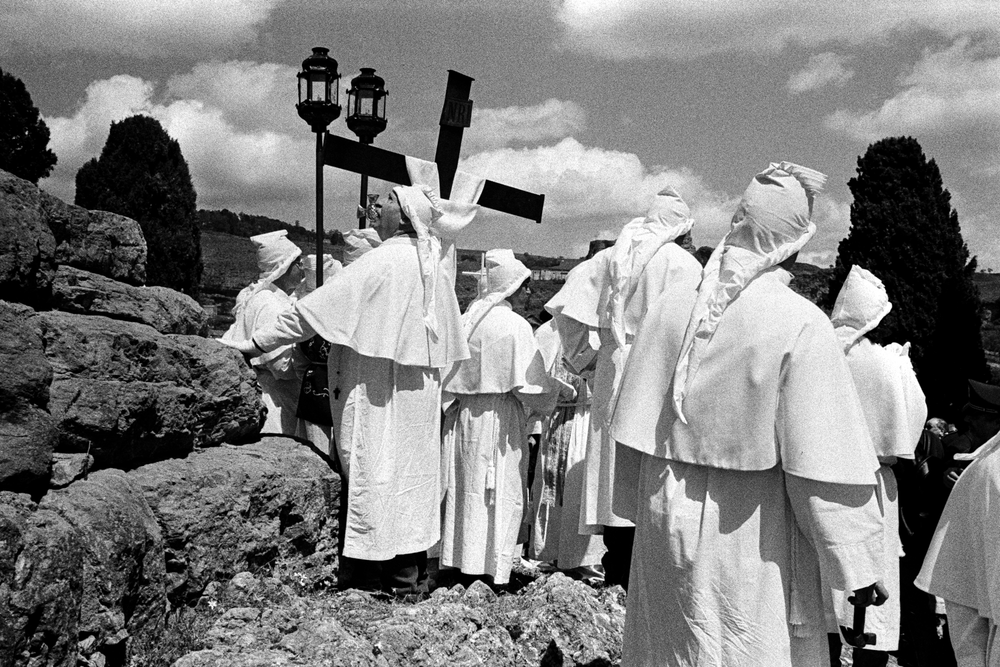
Leading the procession, the Great Cross is carried between two lanterns, symbols of divine light. Corleone, Provincia di Palermo. Corleone, Provincia di Palermo
After more than four decades, the ban was lifted in 2007 following appeals from Church officials who organized the Easter processions. The decision reflected significant changes in the town's social landscape, including the incarceration of major Mafia figures and a collective effort to distance the community from its criminal past.
Despite the lifting of the ban, the full-face hoods have not been universally reinstated. In many cases, participants now wear hoods that leave the face visible, reflecting a commitment to transparency and a break from the past where anonymity could be exploited for illicit purposes. This adaptation highlights the community’s dedication to preserving religious tradition while confronting and integrating the complexities of its own history.
The Good Friday observances are marked by two deeply symbolic processions that narrate the Passion and Resurrection of Christ through a sequence of sculptural representations.
The day begins in the early morning hours, when the faithful gather to accompany a statue of Christ in a procession to the Calvario - a hilltop site symbolically recreating Golgotha, the place of the Crucifixion. Participants walk in silence, creating an atmosphere of collective mourning and meditation. The statue, a lifelike and intricately detailed representation of Christ in His suffering, is borne aloft by dedicated members of the community, for whom carrying it is considered a sacred honor. Upon reaching the summit, a ritual reenactment of the Crucifixion is performed: the statue is affixed to a large wooden cross, embodying the moment of Christ’s death and inviting the gathered faithful to contemplate the enormity of His sacrifice.
As dusk approaches, the community regathers for a ceremony known as the Deposition. In this ritual, the crucified figure is taken down from the cross. Great care and reverence are shown in every gesture, reflecting the grief of those who tended to Jesus after His death.
Upon returning to the town, the statue of the Sorrowful Virgin is brought forth from the Santuario di Maria SS Addolorata to behold the body of her Son. A large crowd gathers to witness this moving encounter, accompanied by the mournful singing of a children's choir.
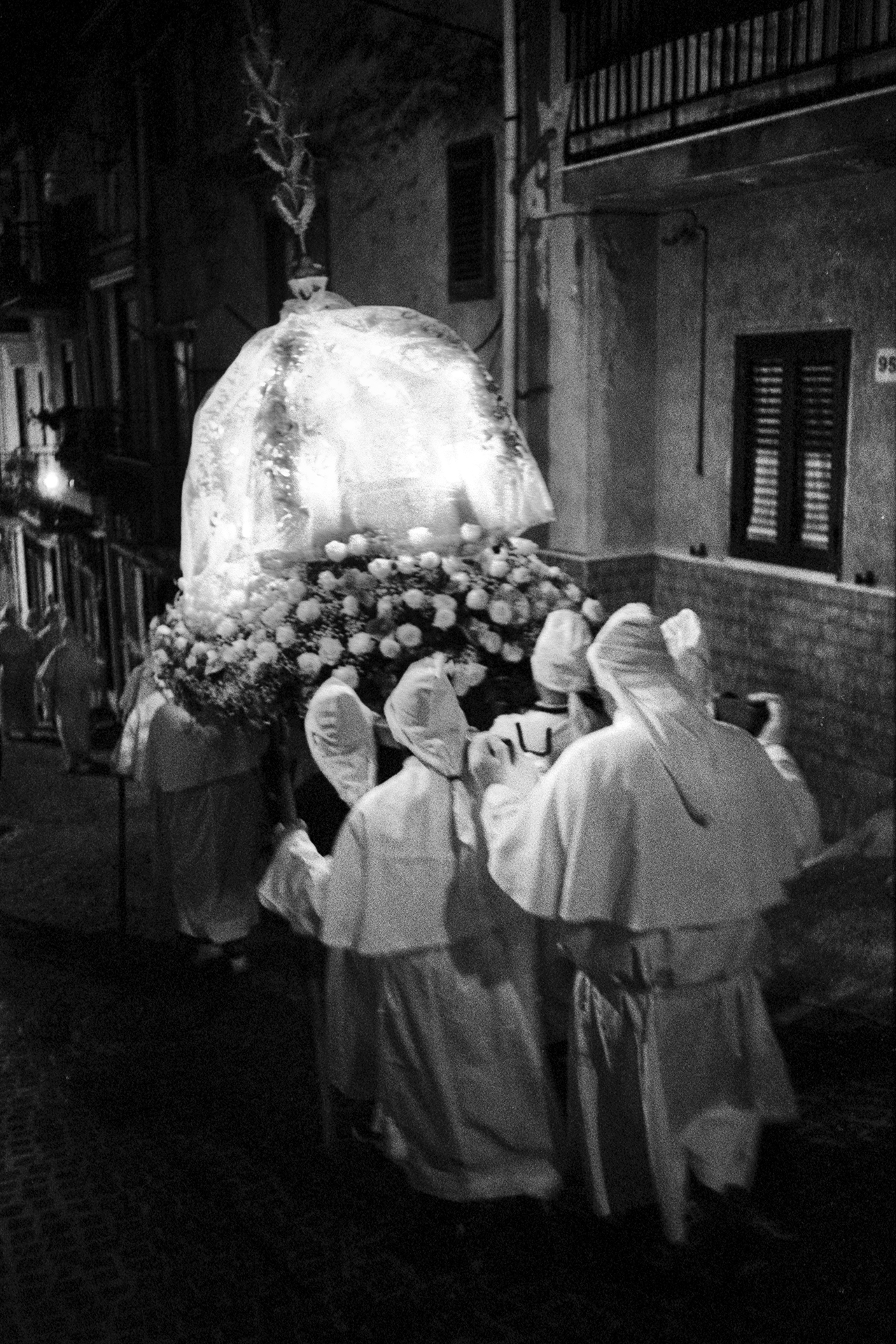
The statue of the crucified Christ is replaced with a second sculpture depicting the entombed Christ, marking the culmination of Good Friday’s mourning. The town falls into silence, awaiting the promise of the Resurrection.
As night deepens, hope begins to glimmer and the figure of the entombed Christ is replaced by the Resurrected Christ, His form radiant with triumph and hope. This final act proclaims the heart of the Christian belief: death is not the end, but the beginning of eternal life.
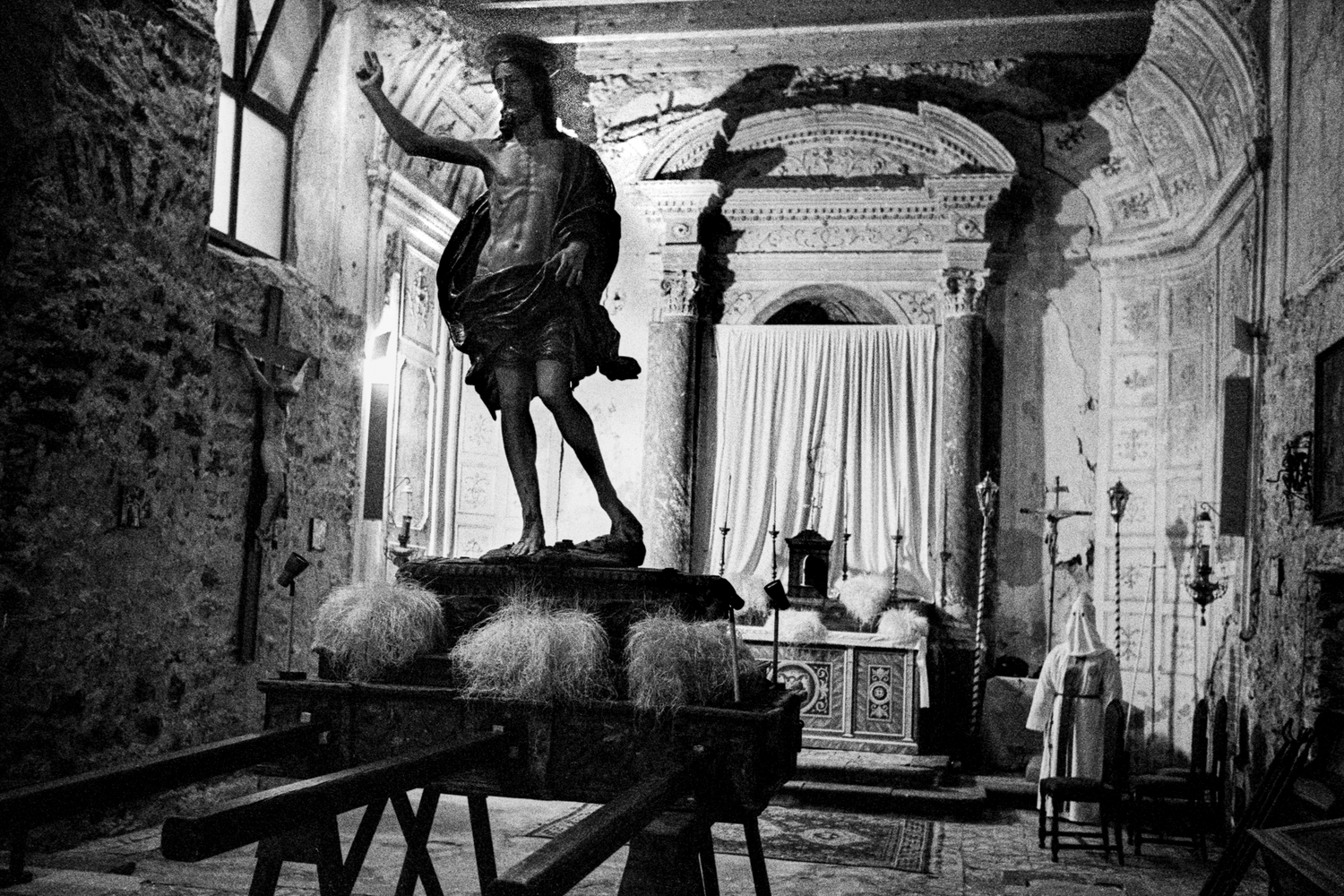
The Resurrected Christ in the Chiesa dell`Annunciata oratorio SS. mo Nome di Gesù. Corleone, Provincia di Palermo
The mournful cadence of drums and the familiar strains of traditional hymns accompany the processions, weaving a tapestry of sorrow and joy. In this shared ritual, Corleone bears witness to a centuries-old faith that continues to endure, inspiring both remembrance and renewal.
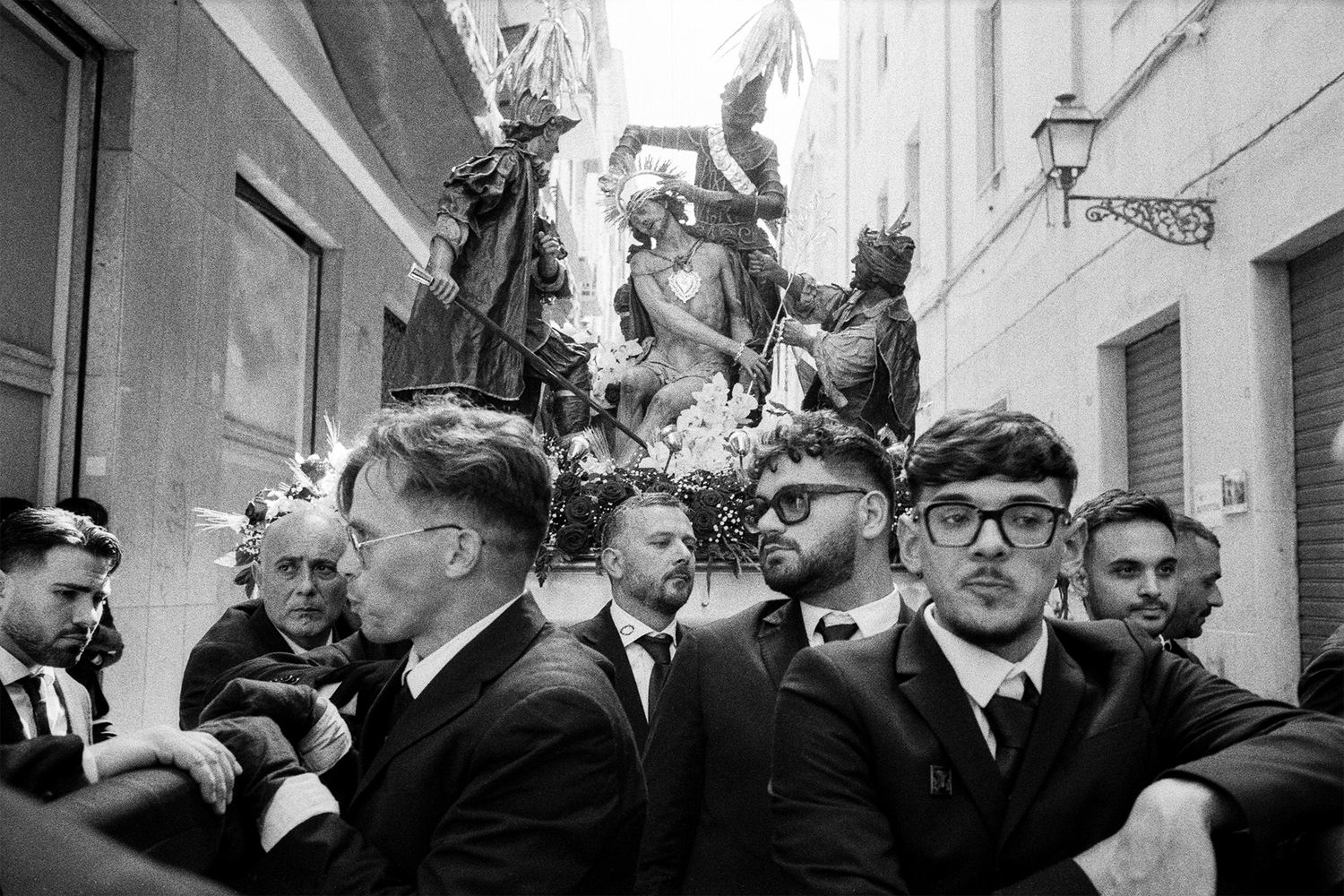
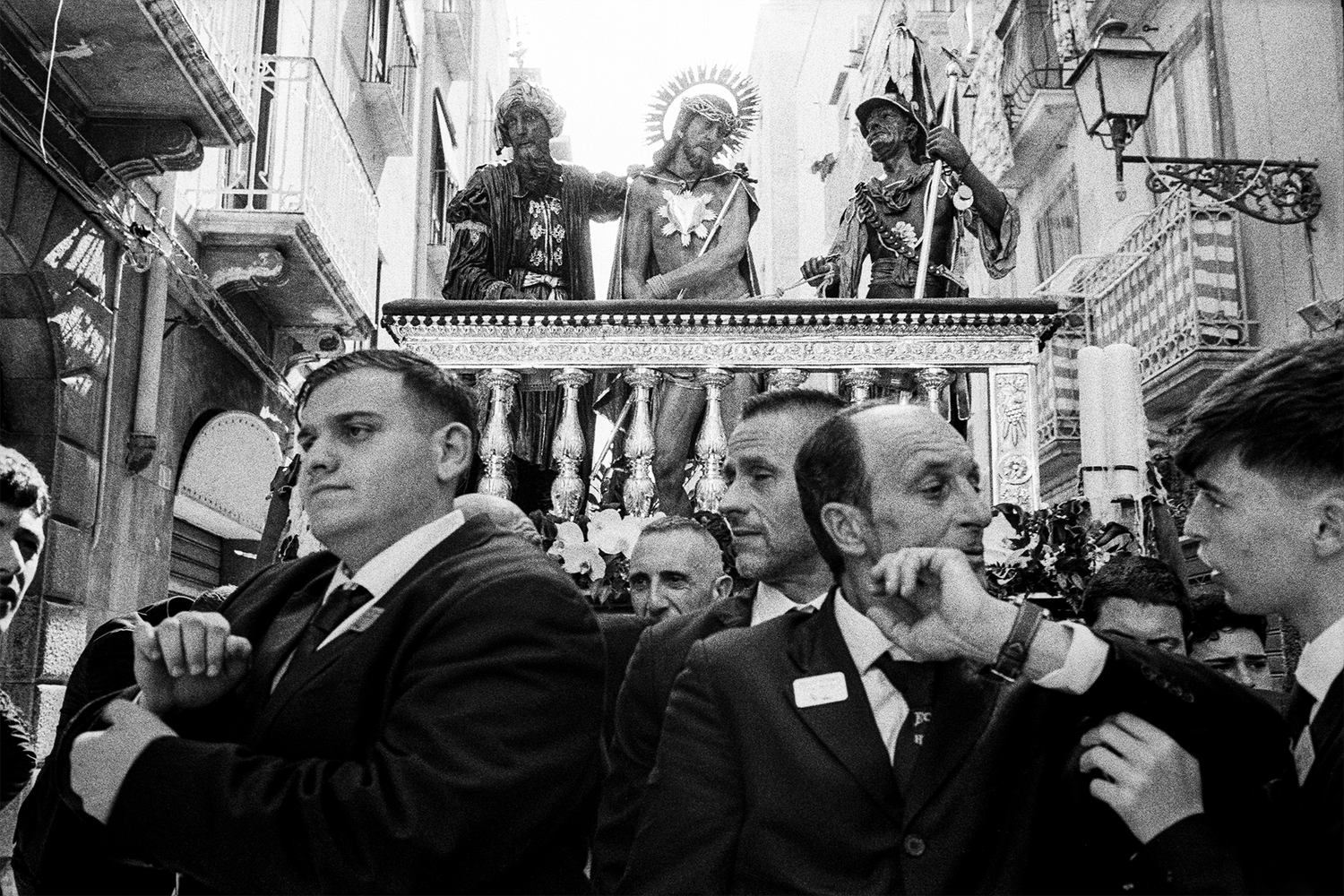
The Crowning with Thorns (left) and the Ecce Homo! groups (right) are two of the twenty sculptural groups carried through during the Good Friday procession. Trapani, Provincia di Trapani
Trapani, on Sicily’s western coast, is renowned for its Processione dei Misteri, a Good Friday procession that ranks among the oldest and most elaborate in Italy. The event features twenty sculptural groups, each depicting a scene from the Passion of Christ. These wooden tableaux, known collectively as the Misteri, were crafted between the 17th and 18th centuries by local artisans and are carried through the city by members of the historic trade guilds, or maestranze, many of which have upheld this role for generations.
At the heart of the event’s organization is the Unione Maestranze, the umbrella association of guilds responsible for coordinating the procession. Each group is overseen by a designated figure known as the massaro, who ensures the maintenance of the sculptural group and organizes its participation in the procession. The role of the massari is both practical and devotional, involving year-round care of the tableau and collaboration with guild members and confraternities.
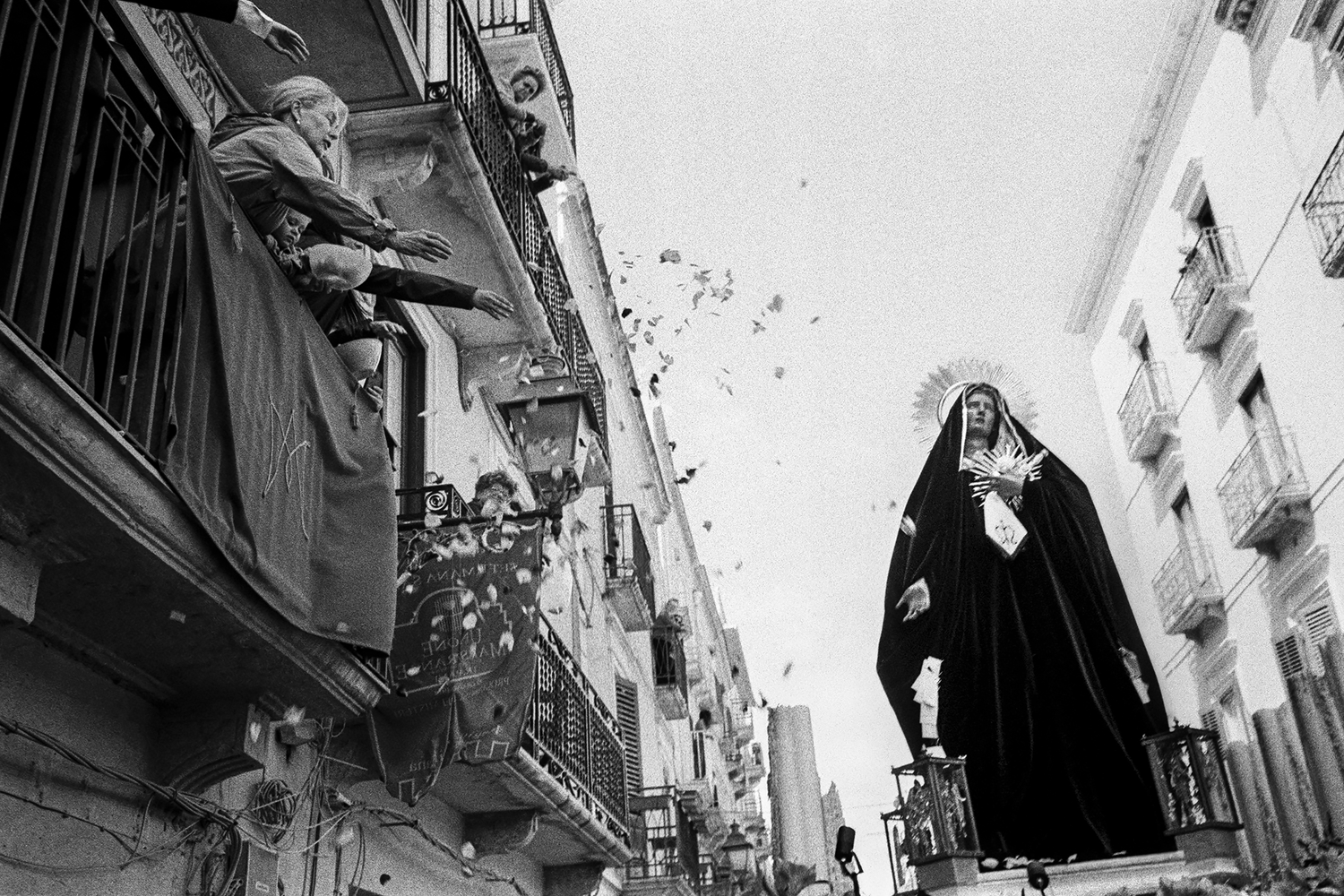
Residents scatter rose petals before the Madonna Addolorata, who is draped in a black cloak. This statue closes the procession, symbolically following the dead body of her Son, which is placed in an urn and carried ahead of her. The statue is believed to be the work of Giuseppe Milanti and is thought to have been created in the early 1700s. Trapani, Provincia di Trapani
The Misteri is among the oldest continuously running religious events in Europe, having been recorded since before the Easter of 1612. Running for at least sixteen continuous hours it is the longest religious procession in Sicily and in Italy.
The Misteri are carried through the streets of Trapani accompanied by slow, mournful music performed by marching bands, with each group walking according to an ancient rhythm called the “annacata,” a subtle swaying motion that gives life and expression to the statues as they move through the city.
The entire event is deeply rooted in the communal and religious identity of Trapani, with preparations and rituals extending throughout the Lenten season. The procession serves not only as a display of religious devotion but also as a living expression of the town’s artisanal heritage, social history, and intergenerational continuity.